


The absurd conspiracy of Prince George’s ‘older sister’
The absurd conspiracy of Prince George’s ‘older sister’

Marianka SwainSun, September 20, 2026 at 12:00 PM UTC
0
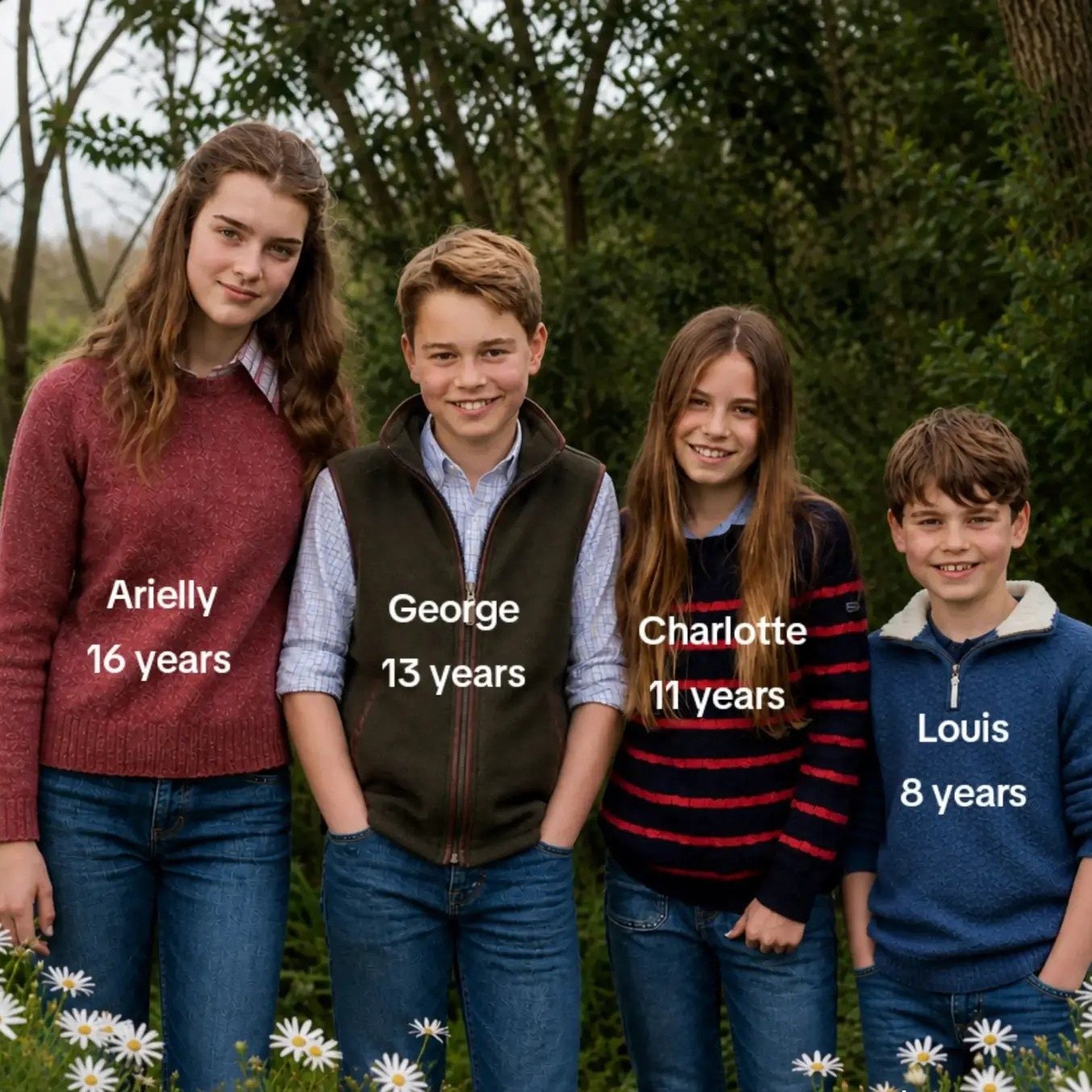
The AI-generated image claiming there is another, older princess - Instagram: @royalreporterlydia
It’s a busy time for royal news, what with Harry and Meghan’s return to England and the publication of Earl Spencer’s incendiary memoir. But the most bizarre royal story in circulation is one that has played out on social media: a scurrilous online conspiracy theory makes the baseless claim that Prince George is not the oldest Wales child; he has a secret older sister named Princess Arielly.
This is, of course, complete and utter nonsense, but that hasn’t stopped it from gaining traction. One royal-news-loving user on Instagram, @royalreporterlydia, posted a warning about the proliferation of fake online content, along with an illustrative screenshot of an AI-generated image that purports to show Prince William and Princess Catherine’s four children with labels reading “Arielly 16 years, George 13 years, Charlotte 11 years, Louis 8 years”.

The real, entire family of the Prince and Princess of Wales in August 2026 - Getty/Jeff J Mitchell
As commenters on the post pointed out, the supposed Princess Arielly bears a strong resemblance to a young Brooke Shields. Meanwhile, actual images of the Wales children have been spliced into this ghastly AI-generated fake family portrait – for example, Princess Charlotte was photographed in that striped jumper for her 11th birthday. It’s this blurring of real and completely fictional that is so strange and eerie.
But why on earth would anyone bother to posit this clearly bogus idea? It’s so easily disproven, given the extent to which the Royal family’s lives are publicly documented. In some ways, it’s not surprising: the internet has always been a hotbed of bonkers conspiracy theories, especially those involving prominent figures – such as the vile, unfounded story that Brigitte Macron was actually born male, which led to a cyberbullying conviction for 10 people in January.
However, some of the conspiracies about the Royal family, such as a recent false allegation that the King had secretly converted to Islam, appear to be part of an insidious, targeted disinformation campaign. The claims are amplified by so-called “bot farms” (operatives using a wall of mobile phones to send multiple messages from fake accounts) in Southeast Asia, which are likely funded by a different foreign actor, such as Russia. There is concern among Palace officials that the Royal family is being targeted in this way, according to The Times.

Brigitte Macron has been a victim of conspiracies that baselessly claim she was born male - Getty/Leon Neal
“This is something we’ve been looking at for a while,” explains Amil Khan, chief executive of Valent, an AI company that works with public and private-sector organisations to track and respond to manipulation online, and which spotted this fake royal news trend. “We monitor 15 coordinated influence networks in the UK, and we noticed that just before the King’s state visit to America earlier this year, there was a growing campaign attacking him. These networks are collections of hundreds of social media accounts that post and repost each other’s content, so together they were reaching six million people. It’s like a corrupted version of social-media marketing.”
The automated Facebook accounts that were key to the false King-converting-to-Islam story gaining traction were based in Vietnam, Valent discovered. “It’s basically a decentralised, high-tech version of a cottage industry,” Khan explains. “The people funding this are elsewhere: they’re paying in cryptocurrency, and the actual delivery and execution is happening in Vietnam. The bot-farm workers are essentially service providers.”
However, that makes it much trickier to prove who is really behind it all, especially as the crypto payment can pass through multiple jurisdictions. “When we first started tracking these campaigns, we could see if it was very obviously a Russian or Chinese network,” says Khan. “But now it’s hard to tell if a particular government or political party is at the root of it. It gives them plausible deniability. This whole space of online manipulation is sophisticated and murky at the same time.”
Khan believes the disinformation campaign about the King converting to Islam was “intended to derail the [American] state visit by suggesting he had betrayed Britain and Christianity. They pushed that attack line really hard for a good three or four weeks. I wonder if they were aiming for a Zelensky-in-the-Oval-Office-type [of] explosive moment between the King and President Trump”.
Advertisement
Henry Ajder, an AI and deep-fake expert who has been working in this space since 2018, says: “The president of the United States seeing something on his social-media feed which is red meat to his base, so he repeats it, and that it might then impact the relationship between the US and UK, that just doesn’t seem as far-fetched as it would have done 10 years ago.”
In fact, the conspiracy was picked up by former New York mayor, and Trump’s former attorney, Rudy Giuliani, who said in an interview with Piers Morgan: “I have people from England telling me you’re going to be a Muslim country in 10 years… Charles III might be the Muslim monarch of England.”
The proliferation of ever-more-convincing AI “has made it worse”, adds Ajder, “because there is more doubt than ever about the authenticity of content. Our shared reality is under threat.” He also notes, however, that AI content doesn’t actually have to look perfect “so long as it’s highly emotive – it can act like propaganda or caricature. It just needs to speak to something that aligns with people’s deeply held views: it must feel real”.
As for why figures such as the King are being targeted, Ajder observes: “The Royal family are a great symbol of this country. By attacking their reputation on the global stage, you could potentially influence the perception of the UK geopolitically.” The Royal family also has considerable soft power when it comes to diplomatic relations. “If a foreign actor is looking to sabotage, say, the UK’s relationship with the US, you could see them attacking the King as part of an ongoing effort to undermine us,” says Khan.

There were concerns that the recent claims concerning the King were created to derail his state visit to America earlier this year - Getty/Kevin Dietsch
Similarly, a deepfake of a supposed hidden older princess might seem utterly ridiculous. But there could be a malicious intent behind such an absurd conspiracy, such as questioning the legitimacy of Prince George as an heir to the throne.
Other AI-generated images, such as the peculiarly bad-taste trend of showing Princess Diana meeting her grandchildren, are even less likely to be believed, but it’s all part of “a flood of information”, as Ajder puts it. “It’s a classic Russian playbook.” He also compares it to Hannah Arendt’s theory of propaganda: “When people are bombarded with competing claims, they become so confused they just switch off.” Khan notes that when we constantly see images conveying the same idea, “we subconsciously begin to accept it. It’s a drip-drip feed that shapes our worldview”.
People are at least becoming more aware of the concept and effects of disinformation, says Ajder, “but that hasn’t translated into any meaningful action from social media companies. Addressing it would likely be prohibitively expensive and might get them into knotty conversations with various governments about free speech.”
But what about the wider implications for public trust and national security? “That’s something I worry about a lot,” says Khan. “This is a new form of warfare. It’s cheap, deniable, relatively risk-free and it has a demonstrable impact.”
A fake story about the King or a member of the Royal family might seem harmless enough, even rather ludicrous. But there is a darker side to this seeming nonsense: it’s an attack on a trusted British institution, one which could undermine our faith in our leaders and in our world.
Source: “AOL Entertainment”
